
NVIDIA is reportedly collaborating with Google's "Quantum AI" division, focusing on the enablement of next-gen quantum computing devices.
NVIDIA Reveals Extensive Collaboration With Google On Quantum Computing, Advancing Into The Future
[Press Release]: NVIDIA today announced it is working with Google Quantum AI to accelerate the design of its next-generation quantum computing devices using simulations powered by the NVIDIA CUDA-Q platform.
Google Quantum AI is using the hybrid quantum-classical computing platform and the NVIDIA Eos supercomputer to simulate the physics of its quantum processors. This will help overcome the current limitations of quantum computing hardware, which can only run a certain number of quantum operations before computations must cease, due to what researchers call “noise.”
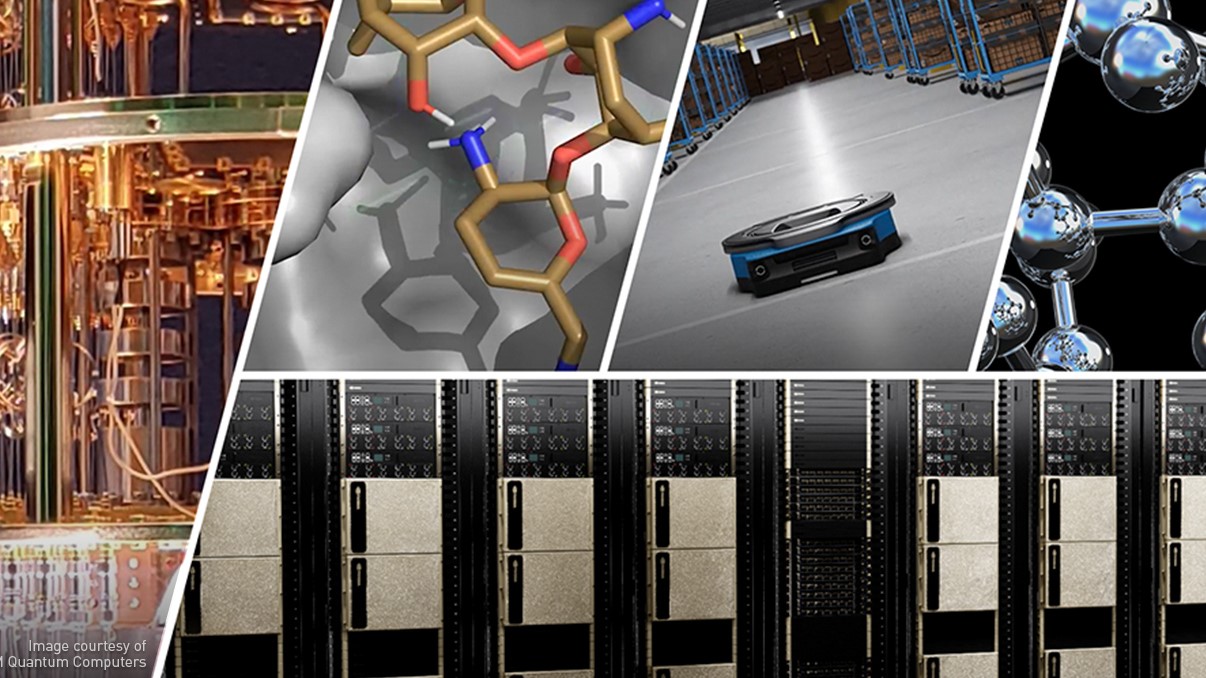
Understanding noise in quantum hardware designs requires complex dynamical simulations capable of fully capturing how qubits within a quantum processor interact with their environment. These simulations have traditionally been prohibitively computationally expensive to pursue. Using the CUDA-Q platform, however, Google can employ 1,024 NVIDIA H100 Tensor Core GPUs at the NVIDIA Eos supercomputer to perform one of the world’s largest and fastest dynamical simulation of quantum devices — at a fraction of the cost.
With CUDA-Q and H100 GPUs, Google can perform fully comprehensive, realistic simulations of devices containing 40 qubits — the largest-performed simulations of this kind. The simulation techniques provided by CUDA-Q mean noisy simulations that would have taken a week can now run in minutes.
The software powering these accelerated dynamic simulations will be publicly available in the CUDA-Q platform, allowing quantum hardware engineers to rapidly scale their system designs.

About the author: Muhammad Zuhair is a hardware and technology reporter for Wccftech, specializing in the semiconductor industry and the complex interplay between technology, manufacturing, and geopolitics. His coverage focuses on the corporate strategies and technological roadmaps of industry giants like TSMC, NVIDIA, Samsung, and Intel. Zuhair's expertise lies in deconstructing complex topics such as fabrication nodes (e.g., 2nm process), the economic impact of policies like the CHIPS Act, and the strategic development of AI infrastructure from NVIDIA, AMD and Intel.
Follow Wccftech on Google to get more of our news coverage in your feeds.


