
Microsoft has now enabled the "highly-anticipated" neural rendering with its DirectX API, allowing GPUs to leverage AI capabilities to transform graphical computation.
Microsoft's DirectX API To Support Neural Rendering, Allowing Realtime Processing of Graphics With The Power Of AI, Unlocking Full Potential of NVIDIA's RTX 50 GPUs
Well, neural rendering in GPUs is the next big thing and is currently the industry's on the topic. We saw how NVIDIA's CEO Jensen Huang described the importance of neural rendering in learning and predicting elements of the rendering process, and it seems like the industry is finally transitioning into this idea.
In a blog post, Microsoft revealed that DirectX will now support neural rendering across different architectures, along with adding in "cooperative vector" support to DirectX, ultimately accelerating AI workloads across consumer and professional GPUs.
Microsoft is excited to partner with NVIDIA to catalyze this next generation of graphics programming by bringing industry-wide support for neural shading technology.
DirectX will soon support Cooperative Vectors, which will unlock the power of Tensor Cores on NVIDIA GeForce RTX hardware and enable game developers to fully accelerate neural shaders on Windows
- Bryan Langley, Microsoft
For those unaware, cooperative vector support refers to a method of GPUs to process data, by dynamically adjusting the processing of data in groups of varying sizes. This is done by optimizing matrix-vector operations, and through this, not only will the AI workload process be much faster, but the cooperative vector allows more efficient utilization of GPU resources for variable-sized data processing, allowing developers to leverage the feature for optimal neural rendering output.
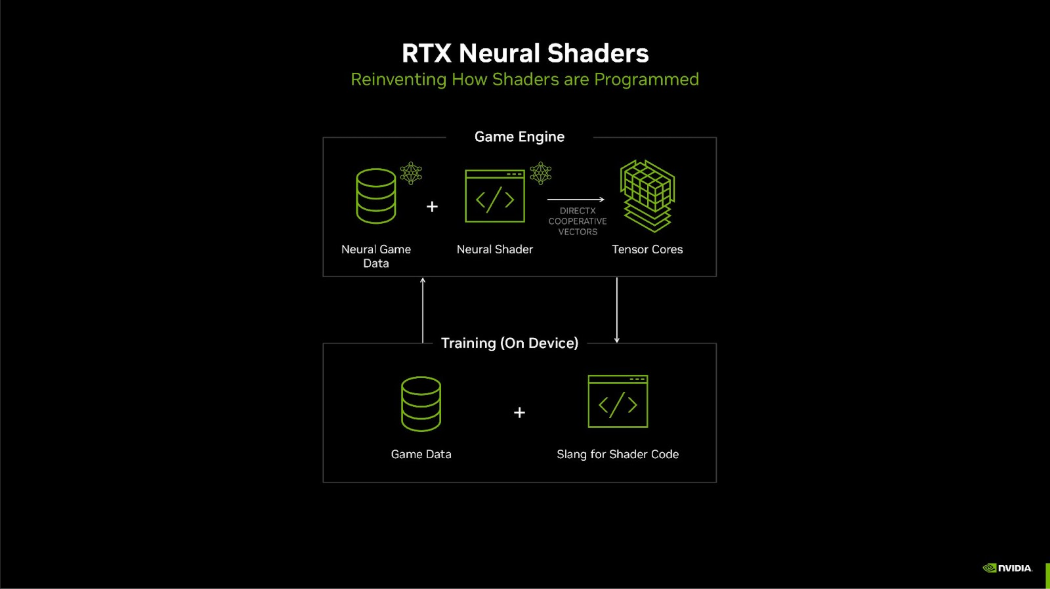
Microsoft has also validated that DirectX neural rendering and cooperative vector implementation will be supported by NVIDIA's newest RTX 50 series GPUs, allowing the onboard Tensor Cores to enable neural shaders. This will allow developers to create AI-powered visualization, optimal path-tracing algorithms, and even generate realistic images and objects much more effectively, paving the way for more realistic and immersive graphics experiences.
Microsoft is working with partners such as AMD, Intel, NVIDIA, and Qualcomm to integrate cooperative vector support into the DirectX ecosystem, allowing AI-accelerated graphical computation to flow much more seamlessly.

About the author: Muhammad Zuhair is a hardware and technology reporter for Wccftech, specializing in the semiconductor industry and the complex interplay between technology, manufacturing, and geopolitics. His coverage focuses on the corporate strategies and technological roadmaps of industry giants like TSMC, NVIDIA, Samsung, and Intel. Zuhair's expertise lies in deconstructing complex topics such as fabrication nodes (e.g., 2nm process), the economic impact of policies like the CHIPS Act, and the strategic development of AI infrastructure from NVIDIA, AMD and Intel.
Follow Wccftech on Google to get more of our news coverage in your feeds.


