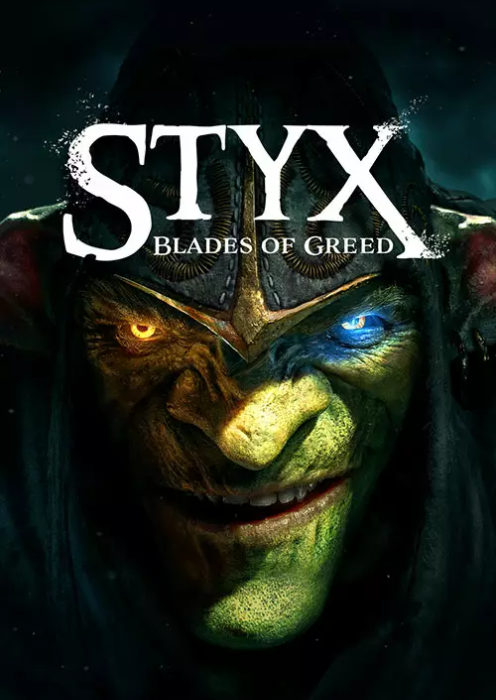
Cyanide's Styx series may not be a household name for stealth games, but it still managed to carve out a niche for itself thanks to its solid gameplay and personable protagonist, a rogue goblin called Styx who's never afraid to voice his mind. No one would probably call Styx: Master of Shadows and Styx: Shards of Darkness the most accomplished of games, but, at the same time, no one would deny how both games have plenty of heart.
For nine years, Styx and his begrudging companions, including the former goblin hunter Helledryn and the dark elf Djarak, have been away from our screens, and for their return, Cyanide planned something big. Since the launch of Shards of Darkness, video games have changed a lot, and a linear stealth experience wouldn't have cut it.
As such, Styx: Blades of Greed overhauls the series' formula with a more complex world design, sandbox features, and a more open-ended structure that make the experience feel quite modern. Though still a little rough around the edges, the game delivers an engaging stealth experience without sacrificing the heart that has always characterized the series.
An Unquenchable Thirst For Quartz

Following the end of Shards of Darkness, Styx returns in a new adventure where he is hunting for Quartz, a magical resource that is as powerful as it is dangerous for any who can absorb it. This time around, Styx doesn't have to rely solely on his wit and caustic humor. Alongside Helledryn and Djarak, the rogue goblin assembles a crew to help him secure the Quartz while staying one step ahead of the Inquisition. Their journey provides a front-row seat to the onset of the Great War and the eventual formation of the Black Hand, the legendary mercenary group first seen in Of Orcs and Men.
Although Styx: Blades of Greed does not attempt to do anything revolutionary with its characters and fantasy settings, there's no denying that Styx remains a compelling protagonist and the most interesting member of the cast. His trademark caustic humor is intact, and his remarks on anything that happens around him make the adventure memorable. On the other hand, the game provides a slightly deeper look at the goblin: every time he absorbs a fragment of Quartz, Styx is confronted by a mysterious entity called the Flux, which not only plays an important role in the story, but also offers the chance to delve deper into the goblin's personality and motivations, painting a slightly more rounded picture of the character.

While the supporting cast lacks Styx’s magnetic cynicism, they are fleshed out enough to feel like functional parts of the machine rather than mere set dressing. Generally, there really isn't anything so memorable aside from Styx that would get anyone to delve deeper into this fantasy world's lore, but what is there is interesting enough to provide a decent enough motivation to push towards the next Quartz.
Just a Goblin in an Open World

As mentioned earlier, developer Cyanide couldn't go with the same linear sort of stealth experience featured in the previous entry in the series for the new game. The stealth genre has greatly evolved since the days of Shards of Darkness, with an emphasis on open-level design and sandbox mechanics that simply couldn't be ignored in Styx: Blades of Greed.
In this regard, the new entry in the series delivers, for sure. Locations such as The Wall, the lush orc village of Turquoise Dawn, and the Ruins of Akenash, the elven capital, are much more open than anything the series has featured to date, with an open-world sandbox flair that gives the adventure a very personable feel.
Even in the Prologue, this feeling is unmistakable. Reaching The Wall with their zeppelin, Styx and his gang find themselves stranded in a location filled with all sorts of dangers, ranging from gangs of thieves and marauders and the powerful Inquisition, and it will only be with the help of some new allies that they will be able to take it up to the skies again in search of Quartz. Although in this early segment of the game Styx will have to recruit a new dwarven pilot and save a specific individual from the Inquisition in a set order, the openness of the experience is evident.

These early objectives may be set, but the options are not: to infiltrate the tavern where the dwarf pilot resides, for example, players can scale the tavern itself to enter the dwarf's room from a window, or infiltrate it from the main entrances, creating all sorts of distractions for the enemies inside, and so on. Right from the onset, the locations' vertical design is remarkable, providing so many opportunities for stealth and concealament that make the experience very engaging from the get-go, even with the limited tools Styx has at his disposal in the first few hours, which will be later expanded via the game's progression system with new gadgets and special powers, including the ability to create clones, improved perception to spot enemies hidden by environmental elements and so on.
Once the first Quartz is absorbed and the crew takes to the skies again, the training wheels come off, and it's here that the experience turns into a full sandbox stealth game. With a compass in tow, Styx will have to search for multiple Quartz fragments scattered all over locations in any order the player wishes, with a challenge that can be greater or lower depending on the unlocked upgrades, with only the occasional forced story quest acting as a progression threshold every now and then. These Quartz-hunting missions are also quite varied and are never as straightforward as simply reaching a location. Something unexpected always happens, forcing players to always be on their toes and never grow complacent.

Besides featuring a solid vertical design, the Styx: Blades of Greed maps have a marked Metroidvania feel centered on two of Styx's new tools: the Grappling Hook and the Glider. Unlocked a few hours into the adventure, both tools can be used toaccess previously unaccesible locations, making not only the entire experience deeper with new stealth options, but also make progression more meaningful in a very tangible way, especially in light how many of core's upgrades to Styx's toolset are maybe unlocked a tad too slowly, often requiring multiple Quartz shards and Blueprints to unlock via the game's skill trees.
Still, these unlocks are rather rewarding, especially the Quartz powers that give Styx some very powerful tools, such as Mind Control, moving at Super Speed, and unleashing a Flux Blast to get rid of enemies. These, in combination with the passive abilities granted by Runes, give a sort of build flexibility in a game that has no loot whatsoever.
I Am What My Enemies Make of Me

Another core element that is required for a proper stealth experience is a solid enemy AI, but it's here that Styx: Blades of Greed starts to show some cracks. Although enemy variety is overall decent, with multiple human and non-human enemies, including stronger enemies that cannot be disposed of with a single stealth kill attempt and require more guile to eliminate, their AI leaves something to be desired at times. Their keen hearing forces players to proceed carefully to avoid tripping over chairs and other environmental elements, making noise, and their reasonable, decent sight, especially at long distances, forces a careful approach. However, there are times when the enemy doesn't see Styx even if he is located nearby and not exactly in concealment.
Thankfully, at the very least, enemies are relentless when alerted and will hunt Styx until he manages to get away, so the experience remains challenging, even if the AI sometimes falters. Unfortunately, it's during these frantic escapes that the roughness of the experience is felt the most: the basic control scheme is a little complicated, and doesn't feel very natural at the beginning, leading to the wrong action at the wrong time; melee combat is terribly basic, limited to a dodge and dagger attack, and requires locking onto an enemy first, which is an unnatural setup for most third-person action games. In addition, there are too many times when Styx is stuck mid-jump in geometry elements, which can lead to some undeserved defeats in certain situations.

Luckily, any defeat is not the end of the world, as Styx: Blades of Greed allows players to make quick saves at almost any time, even with a controller. This is a great quality-of-life inclusion that was essentially required, as the game does often rely on trial-and-error, especially at the beginning, and the experience would have been way too frustrating without it. Hardcore fans of the series can ignore this feature and even disable it altogether by playing the game at the highest difficulty level.
Weighing what the game does well, and what doesn't in gameplay terms, it's clear how Blades of Greed sits comfortably in the same space as its predecessors. It doesn't revolutionize stealth gameplay in any way, it's a little rough around the edges, lacking some quality-of-life features such as a detailed map that would be essential for a sanbox experience like this (a few times too many I had to look around the map to find a fast travel point that would bring me to the airship), has imperfect enemy AI and cumbersome controls, and maybe too much trial-and-error, but it compensates this with great level design, and a lot of heart, which is evident in its around 20 hours long experience. The total playtime can vary a lot depending on your stealth skills and how much you explore locations for optional items, and if you engage with character-focused side objectives that provide some light development to Styx's crew.
Unreal Engine 5 Grinds Impertinent Goblin Into Dust

The convoluted controls, the main character sometimes getting stuck in environmental geometry, and the wider assortment of bugs (including being able to take down enemies by grabbing them through walls), unfortunately, are only the tip of the proverbial iceberg regarding Styx: Blades of Greed's technical state. Given the level of visuals the game pushes, which are acceptable but far from groundbreaking, one would expect solid performance. Unfortunately, that is not the case.
Powered by Unreal Engine 5, on PC, the game suffers from the widely known traversal stuttering issues, for which nothing the shader pre-compilation step can do. They are not terribly frequent, but they happen often enough that it is impossible not to notice them.


General performance does not fare well, either. On my high-end system (i7-13700F, RTX 4080, 32 GB RAM), the game averaged 55 FPS, 27 1% low, in a benchmark session conducted on The Wall map at 4K resolution with DLSS in Balanced mode, high settings, and no Frame Generation. Needless to say, the game would be essentially unplayable without upscaling on anything but the absolute top-end systems.

Thankfully, hitting close to 60 FPS without any frame generation tech made the gameplay relatively smooth with either DLSS or FRS Frame Generation. As it isn't an intense action title that requires split-second reactions, this is generally more than enough to enjoy it, no matter how technically disappointing this level of performance is. However, since most players don't have a beefy system like mine, I'd suggest you wait for more tests on lower-end hardware before committing to a purchase on PC if you don't have a top-end machine
Closing Thoughts

Despite the technical friction and a 20-hour runtime that becomes slightly repetitive toward the end, Styx: Blades of Greed is a solid stealth title. It doesn't revolutionize the genre, and it lacks a much-needed in-game map for its sandbox maps, but it compensates with excellent level design and immense heart. For fans of the series or those craving a pure stealth experience, Styx's hunt for Quartz it’s a journey worth taking.
PC version tested. Review code provided by the publisher.


About the author: Francesco De Meo has been covering video games and technology since 2012, starting his career at small outlets like Gamersyndrome and GeekSnack. After joining Wccftech gaming section in 2015, he quickly expanded his video gaming coverage with in-depth reporting, interviews with iconic industry figures such as Grasshopper Manufacture founder and No More Heroes creator Goichi "Suda51" Suda, Resident Evil series creator Shinji Mikami, Team NINJA's president and Nioh series director Fumihiko Yasuda, and Silent Hill creator Keiichiro Toyama, reviews and on-the-ground coverage of major industry events such as Gamescom and E3. When he's not reporting or reviewing, Francesco can be found playing the genres he loves most, spending time with his six cats, reading, writing music, playing guitar and drumming for his progressive rock band.
Follow Wccftech on Google to get more of our news coverage in your feeds.