


On the eve of the current generation of consoles, CAPCOM announced a brand-new sci-fi intellectual property called PRAGMATA. It was the Japanese studio's first new global franchise since 2012's Dragon's Dogma, and a return to sci-fi for a studio historically more focused on other settings, such as zombie horror and fantasy.
Following the initial trailer from PlayStation 5's The Future of Gaming event, though, PRAGMATA largely disappeared from radars. Its original launch window was 2022, but it wasn't until June 2023 that we got another trailer, and then there were two more years of silence. Finally, in June 2025, CAPCOM confirmed a 2026 launch, and the Japanese studio successfully kept its promise.
In the final stretch, the developers finally unveiled the game's mechanics and allowed press and even gamers to check it out ahead of the launch with the Sketchbook demo, which is still available on all platforms for those still on the fence about purchasing this title. Having played the demo first at Gamescom 2025, then at home, and now finished the full game, I can say it's an accurate slice of the overall PRAGMATA experience: a fun action game that hearkens back to an era of simpler games but fails to be truly memorable.
- A Unique Combat Loop Built Around Hacking
- An Arsenal Worth Experimenting With
- Old-School Simplicity, For Better and Worse
- Where PRAGMATA Shines - Literally

A Unique Combat Loop Built Around Hacking
PRAGMATA offers exactly one unique mechanics: Diana's hacking, which allows protagonist Hugh Williams to bypass the androids' defenses and deal proper damage with conventional weapons. As those who've played the Sketchbook demo (or watched any gameplay video) already know, hacking happens in real time; players must navigate the grid to reach the target tile, avoiding obstacles and activating optional bonus nodes that can provide combat advantages, such as increased weapon damage.
All the while, they must remain vigilant against enemy attacks. This creates a special kind of friction that is quite unusual: most action games let you focus entirely on the enemy's moves to dodge and counter them optimally, but PRAGMATA requires you to literally read their move with just your peripheral vision and still be able to dodge with the jetpack's thrusters at the right time. Granted, the movesets of most foes featured in this game aren't nearly as complex as they would be in a traditional action game, to compensate for the player's split focus.
This admittedly creates a different kind of combat experience compared to what action fans are used to. It may feel a bit awkward at first, as this type of mini-game is normally reserved for non-combat situations, but PRAGMATA's real time hacking succeeds in providing an original gameplay experience that is also very fun in its own way, especially after you've gotten the hang of it.

An Arsenal Worth Experimenting With
The above is even more true once you unlock additional weapons and tools that were absent in the Sketchbook demo. First, though, I should explain how weapons work in this game. Only primary weapons are always at Hugh's disposal; in the demo and at the beginning of the game, it's the Grip Gun, a mid-range pistol that fires standard rapid-fire projectiles with unlimited ammo. There's a significant catch, though: there are only six shots per clip, and reloading replenishes one round at a time rather than swapping a full magazine, unlike in a traditional shooter. This means you have to make each shot count, especially since the non-primary weapons are essentially "expendable power-ups" with finite ammo and can even break down if overused.
Throughout the whole game, players must constantly adapt to whatever weapon is provided to them. Each has its own advantages. Among Attack Units, the Shockwave is the equivalent of a close-range shotgun, the Charge Piercer is basically a sniper rifle, the Photon Laser is a bit like a mini-gun (albeit one that increases its damage the longer the beam is sustained), Homing Missiles are great for crowd control, and the Jackhammer, the only melee weapon as well as the only one that deals decent damage even before an enemy's defense are hacked by Diana.
Then there are Tactical Units, like the Stasis Net (already seen in the demo), always handy for whenever you need more time to perform a hack, and the Riot Blaster, which is great to knock down and damage multiple foes in an area. Finally, you can also unlock Defense Units. By far the most useful, at least in my opinion, is the Decoy Generator, which creates a holographic replica of Hugh that is always targeted by androids. The Impact Barrier is also situationally useful, creating a barrier that most enemies and projectiles cannot penetrate.
About halfway through PRAGMATA, Hugh will also add a new primary weapon to his arsenal, the Pulse Carbine. It's a straight upgrade compared to the Grip Gun, with 21 shots in the clip and fully automatic fire, though it has a slight downside: hitting enemy weak points, which you'll want to aim for at all times, will marginally increase heat buildup.
All of these weapons and even more can be further upgraded in the Shelter. If you've played the demo, you're probably familiar with the Escape Hatches scattered throughout the levels. In the full game, you can use them to go back to the Shelter, a safe haven where Hugh and Diana can rest and, most importantly, the game's equivalent of an upgrade hub. The Shelter itself is automatically leveled (up to level 4) after defeating certain bosses, and each time, the Unit Printer crafting module is stocked with more items and features.
This includes upgrades to all the aforementioned weapons, but also enhancements to the various bonus hacking nodes (Decode, Multihack, Freeze, Confuse, Expose, Heat, and Chain), as well as to the suit's hacking mode (Offense, Strike, Hybrid, Combust, and Boost). Arguably, though, the most important unlocks are abilities like Fast Moves, which slows down time if you dodge at the last moment; Critical Shot, which is a finisher move that can be performed when you successfully pick that bonus node with your target at low health; and Auto-Hacking, which consumes a bit of the hacking gauge to automatically perform a hack.
The Unit Printer also lets you expand another important way to customize the combat experience: mods. Hugh can install various types of mods onto his suit, such as Attack, Hacking, Defense, and Support. There are dozens of mods in PRAGMATA, and up to six mods (when fully upgraded) can be installed at once, allowing for different playstyles. However, I should note that the game's relatively low difficulty means the desire to experiment comes more from the player's desire to try new setups than from a necessity to overcome specific obstacles.

Old-School Simplicity, For Better and Worse
When you start your first playthrough, only two difficulty modes are available: Casual and Standard. The latter won't be anywhere near challenging enough for most players familiar with action games, though. After you've completed your first playthrough, the game unlocks "Lunatic" difficulty, but there really isn't that much of a reason to play PRAGMATA twice (or more). I mentioned earlier that it's like an old-school game; one of the sides to that is its extreme linearity. There are a few secret areas, yes, as well as some combat challenge scenarios (available via the Training Simulator or by unlocking Red Gated Zones with special keys), but there is none of the freedom of exploration that is perhaps the defining trademark of contemporary games.
Even the adventuring part of the game's action/adventure vibe is rather weak. I felt that CAPCOM could have definitely done more with both puzzles (besides the hacking grid) and platforming to provide greater variety throughout the levels. Moreover, despite PRAGMATA taking place on the Moon, only a very small portion of the game is set in low gravity. That's unfortunate, as those brief sections do provide a refreshing change: running is slower in lower gravity, but jumps and thrusters go further, requiring a non-trivial adjustment during combat.
While Steam claimed I had spent 13.5 hours in the game when I finished my playthrough, the game itself clocked my completed save at 10 hours and 52 minutes. Give or take, that's how much you can expect to spend in this game. That said, completing the game once also unlocks New Game + and a new mode called Unknown Signal, which adds a bit of new content just before the final battle and unlocks a new sector. I'm not sure it was a great idea to lock this content to the game's completion; it would have been simpler to add it to the main game.
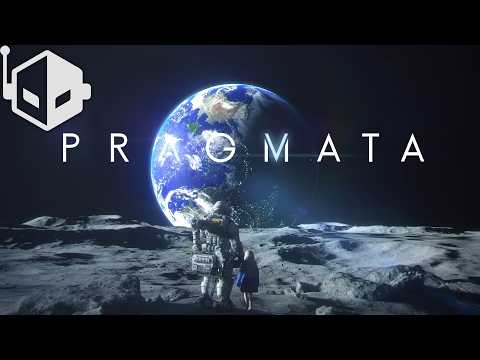
By far, the weakest part of PRAGMATA is its narrative, or perhaps I should say, lack thereof. The plot itself is paper-thin, and even what's there isn't really handled well, though I won't go into spoiler territory. There are fewer than a handful of characters involved; their depth is disappointing, and the final outcome can be seen about as far as the Earth itself in this article's featured image. Overall, I did not mind the game's rather striking simplicity of design and plot, but it is hard not to imagine it could have been so much more impressive and remarkable with greater depth, variety, and narrative.

Where PRAGMATA Shines - Literally
One aspect of PRAGMATA that is unreservedly worthy of praise is the technical one. Powered by the RE Engine, the game delivers stunning path traced visuals with smooth performance. The game's clean sci-fi environments are very well suited to showcase the amazing global illumination and incredibly accurate reflections.
Even with DLAA enabled at 4K resolution, the GeForce RTX 5090 (with the help of 4x Multi Frame Generation) handles path tracing like a champ. There are a few slowdowns during hectic fights and explosions, but overall, they never get in the way of the experience. For guides and more, head to our dedicated PRAGMATA hub, which includes all of our coverage on CAPCOM's new game.
Reviewed on PC (code provided by the publisher).


About the author: With over two decades of experience in gaming journalism, Alessio Palumbo has led the gaming vertical at Wccftech since August 2015. He started working at a young age for Italian websites like Everyeye.it, Gamestar.it, Nextgame.it, and Multiplayer.it before kickstarting the indie English-language publication Worlds Factory as its founder and Editor in Chief. In the last decade, he has coordinated the overall output of Wccftech's gaming section, managed PR relations, assigned reviews, produced daily news coverage, edited gaming content as needed, and delivered game reviews. Arguably, his trademark content is the long series of exclusive developer interviews that have been cited by Wikipedia and by the biggest news media and gaming publications. His passion for technology also makes him knowledgeable when it comes to gaming hardware and tech. His favorite genres include RPGs, MMORPGs, and action/adventure games.
Follow Wccftech on Google to get more of our news coverage in your feeds.


