


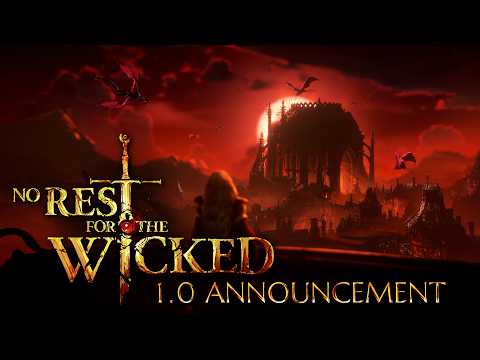
Earlier this month, Ori developer Moon Studios announced the 1.0 launch date of No Rest for the Wicked, its isometric Soulslike fantasy action RPG. The Austrian studio's new project will exit early access in October on PC and PlayStation 5, while Nintendo and Xbox fans will have to wait longer, primarily due to ongoing optimization on the weaker Series S and Switch 2 consoles.
Following the release news, we had the opportunity to interview Moon Studios CEO and Creative Director Thomas Mahler. Throughout the conversation, we delved into the aforementioned decision to postpone the game on Nintendo and Xbox consoles, as well as the game's fairly long development, the main new features and content coming to version 1.0 (new class, progression system, and endgame), and the studio's post-launch plans. Enjoy!
Now that version 1.0 approaches, looking back, did you accomplish everything you originally wanted to do in No Rest for the Wicked, or was there anything you had to cut?
Thomas Mahler: There’s always some stuff we’re not including into an upcoming release, but by now that’s kind of by design. What happened to us on the Ori games was always quite painful: we had features we had spent months on, but when it became clear that we’d not be able to finish them, we had to cut them, and nobody ever saw any of that content, so it literally was wasted time and effort.
On Wicked, we’re now running the studio very differently. Features that don’t make it for a
particular release will just get shelved for a bit and will then get included in upcoming releases.
That results in happier devs and happier players.
When the game launches, it will have been in early access for two and a half years. Was that the timeline you had in mind when entering early access, or did it get longer, and if so, why?
Thomas Mahler: Yeah, it was about the time we thought we’d need. We’re basically just running the Larian playbook in many ways. They had tremendous success with Baldur’s Gate 3, so the plan was literally to release into Early Access, find our community, get all the feedback and telemetry required to really perfect things, and then finish everything.
We knew from the get-go how much content would be available during our Early Access period, and now obviously we can’t wait to see how people will react to playing all this content we’ve been sitting on for some time.
I'm betting you weren't expecting the Private Division situation to go the way it did. Was it challenging to suddenly add self-publishing duties to your development load?
Thomas Mahler: It was difficult for a while since even though Take2 Interactive was pretty great about the whole thing, we didn’t expect them to sell Private Division. But that’s how it goes sometimes in the games industry. As I just said, when that happened, we really appreciated that Take2 was open for negotiations and when they heard about our plan of buying the publishing rights back, they were actually reactive and gave us the time it needed to make that happen. Shout out to Michael Worosz here, who was generally a really decent guy to work with.
The painful bit was that we had just released the project and started to build a community and
while the lawyers were negotiating, we weren’t allowed to say anything publicly, so some
players lost faith early on. Thankfully, I think we got them back after this was all handled and we released more and more updates!
Regarding extra challenge… No, we work in small, dedicated teams and even while we were working with publishers, a lot of the work publishers usually take over was already done by us, so it was a fairly natural process to us.
About a year ago, you sounded the alarm, asking fans who enjoyed No Rest for the Wicked to leave a positive review to help you complete it. How is the sales situation going right now?
Thomas Mahler: I think that situation was a bit misunderstood. We had worked hard on an update and released it too early without enough playtesting and our community definitely taught us the lesson never to do that again. A lot of players complained, we had overtuned things and No Rest for the Wicked was quite brutally difficult upon the release of our ‘Breach’ update. But within a week or so, we released an update that fixed most of the issues players had and over time we got players into good spirits again.
Then we released our ‘Together’ Co-Op update, and No Rest for the Wicked exploded in popularity, becoming the #1 game on Steam for a while, etc. By now we sold almost 2m copies in Early Access alone, so… we honestly couldn’t be happier. Players have clearly shown that they’re hungry for what we’re building for them and we just want to now land the plane safely and give them an unforgettable experience.
One of the things players are most curious about is the new class system. Can you share how it will work and whether it will be available for pre-1.0 testing?
Thomas Mahler: Yep, we’ll make sure that players can test the system before 1.0 launches. Basically, we shipped Wicked with a fairly genre-typical Attribute System, similar to what you’ve seen in plenty of RPGs over the years. We always knew that these attribute systems are alright, but come with some real design flaws that nobody ever properly solved.
I’ve always been a huge fan of Yasumi Matsuno’s Final Fantasy Tactics and it struck me how
perfect the Jobs System that existed in that game would be for Wicked. I then openly started to
tell our community that there’s one big change I’d still like to make and that change I described
as ‘heart surgery’. So, after we released the Together Update, I officially pulled the trigger and since then we’ve been working on it.
At its core, our class system will basically finally fulfill the vision I think a lot of ARPG players had since the 90s. The easiest way to explain it is… imagine you play your straightforward Sword and Board class, our Guardian. But then you notice that you’re a player who uses backstab a lot. So… in that case, it makes sense for you to play the Assassin class for a while to then acquire those backstab traits the Assassin has. You can then go back to your Guardian and use those traits on the Sword and Board class.
If you played an Assassin in games like Diablo or the Souls series… you never really felt like a true Assassin, right? That’s the problem we’re trying to solve with this system. If you’re into the idea of playing No Rest for the Wicked as a stealthy character that makes you feel like Solid Snake… Well, now we can finally realize that. It sounds simple on paper, but in practice, it’s an ENORMOUSLY complex system with the ultimate goal being that ARPG players ought to be able to fulfill any RPG fantasy they have within No Rest for the Wicked.
What can you tell us about the progression system? Is a respec feature going to be available?
Thomas Mahler: The class system itself is set up in a way where you won’t need to respec. Instead, it works like Final Fantasy Tactics, where instead of spending some points and then having to live with those choices, the challenge comes from actually acquiring those traits, weapon runes and cerim runes in the first place. You’re not just gifted those on each level up, you actively need to work for them by playing that particular class. Given that one of the criticisms that players had so far was that they’d love to have more freedom in trying different weapons, I think we have a bit of a ‘kill 2 birds with 1 stone’ situation here.
You're promising new endgame content and replayability. Can you walk us through this important part of No Rest for the Wicked?
Thomas Mahler: Essentially, what ARPG fans want is to basically ‘play the system’. Campaigns in traditional ARPGs are usually not the best part of those games, and that in itself is something we’d like to solve since we think our campaign is pretty damn great.
But the expectation by now is that once you finish the campaign, the game just keeps going and opens up all new ways to play. We’ll go into more details on what we have coming up for Endgame in our next Wicked Inside’s.
What does the post-launch roadmap look like - free updates, premium DLC, or a mixture of the two? Also, do you plan to support the game for years to come, or will you move toward a new project after a while?
Thomas Mahler: Oh, the plan is to support Wicked for a long time. Obviously, we’ll have to sell enough copies to justify that, but seeing how well Wicked did since our last update and given that we’re still in Early Access, I’m pretty confident that we’ll be able to realize our vision. The idea is that we’ll offer free updates for a while.
It’s all pretty simple: our Systems Designers and our Tech Team will ensure that we squeeze the most out of what we have while our content team will already start working on new expansions. Updates are free, and the big expansions are paid. It’s simple, fair and makes sense and I think players will appreciate that we’re not selling them horse armor or making the entire economy dependent on a constant slew of microtransactions.
Are you going to take advantage of PS5 features like the DualSense's adaptive triggers and haptic feedback? Also, can you share the spec targets for the PS5 Pro version?
Thomas Mahler: We’ll have to see! Right now, the biggest thing to solve is simply optimization. Our Tech team is working diligently every day to ensure the PS5 version is excellent. Once it runs like butter and we all play it every day, features like adaptive triggers, etc., are like the dessert after lunch.
Regarding the Xbox and Switch 2 launches, should fans expect a long wait while you optimize No Rest for the Wicked for those platforms?
Thomas Mahler: That entirely depends on how quickly we find ways to optimize our memory footprint. That’s the biggest issue we’re facing right now. We’re constantly streaming in and out lots and lots and lots of data, and we’re shaving off a few dozen megabytes here, a few more there, etc., constantly. PS5 was the obvious choice as a first porting target since we have the full 16GB of RAM there.
On Nintendo Switch 2 and Xbox Series S, we have around 60% less available memory… so it just requires more optimization. The end goal needs to be that, whatever platform we release on, players get a great experience. Nobody gains anything from us shipping a shoddy port.
Finally, a couple of industry topics. What is your stance on using AI tools in game development? There's a big debate raging on the subject.
Thomas Mahler: I think there’s a big difference between using generative AI for tasks that a human could obviously do better and letting a computer do what a computer should do. For example, I just caught one of our gameplay designers putting together a big Excel for our animators that contained information they needed… but then I jumped in and had AI write a little exporter that just gives them all that information without even having to open up our editor.
So… letting a computer do the insanely laborious tasks that we had to do in the past is A-OK in my book. Those are the tasks we always dreaded to do anyway. When it comes to AI creating art or telling stories… we’re just not there yet. I actually tried it a few times and the result is always the same. The art is generic and the stories and dialogue are laughably bad compared to what talented artists can do.
And even if the results would be there, I think at Moon we just enjoy crafting things by hand so that we’re in total control of the quality of our work.
On a related note, what's the sentiment inside Moon Studios on NVIDIA DLSS 5? Would you use it once available?
Thomas Mahler: That’s not really under our control. People already use tools like ReShade to change visuals from the way developers authored them to look. Again, all of those things are just tools. If players enjoy them and they feel it gives them a greater experience, so be it.
And personally… I’m a purist. I still play my retro games in 240p on a Sony PVM, so… I want to experience content exactly how the artists and programmers behind those titles authored them to be experienced.
Thank you for your time.


About the author: With over two decades of experience in gaming journalism, Alessio Palumbo has led the gaming vertical at Wccftech since August 2015. He started working at a young age for Italian websites like Everyeye.it, Gamestar.it, Nextgame.it, and Multiplayer.it before kickstarting the indie English-language publication Worlds Factory as its founder and Editor in Chief. In the last decade, he has coordinated the overall output of Wccftech's gaming section, managed PR relations, assigned reviews, produced daily news coverage, edited gaming content as needed, and delivered game reviews. Arguably, his trademark content is the long series of exclusive developer interviews that have been cited by Wikipedia and by the biggest news media and gaming publications. His passion for technology also makes him knowledgeable when it comes to gaming hardware and tech. His favorite genres include RPGs, MMORPGs, and action/adventure games.
Follow Wccftech on Google to get more of our news coverage in your feeds.


