
AMD's latest moves in the AI market are too big to ignore, as the firm has now decided to challenge NVIDIA with its highly capable offerings, expanding to rack-scale solutions.
AMD's Upcoming Instinct MI500 Accelerators to Challenge NVIDIA's Powerful Rubin GPUs, Competing Head-to-Head
For those unaware, at the Advancing AI event, AMD announced to the public what to expect regarding the company's AI roadmap, especially regarding the upcoming architectures being introduced by the firm. Over the past few years, NVIDIA has completely dominated the AI hardware segment, with its aggressive offerings, which have scaled effectively into rack-scale solutions, bringing in enormous compute performance. However, AMD is set to pace up competition with their newly announced Instinct MI500 and EPYC Verano CPUs, which reportedly use TSMC's N2P process.

One of the more exciting elements of the Instinct MI500 is that it will be the company's answer to NVIDIA's Rubin architecture, and while the specifics of the series aren't disclosed yet, we do know that the accelerators will utilize TSMC's N2P process, along with the newest packaging methods, like the CoWoS-L. To support the latest accelerators, AMD is set to offer its next-gen EPYC "Verano" CPUs, which will also be built on the high-end 2nm process and will likely utilize either an upgraded version of Zen 6 or next-gen Zen 7 core architecture.
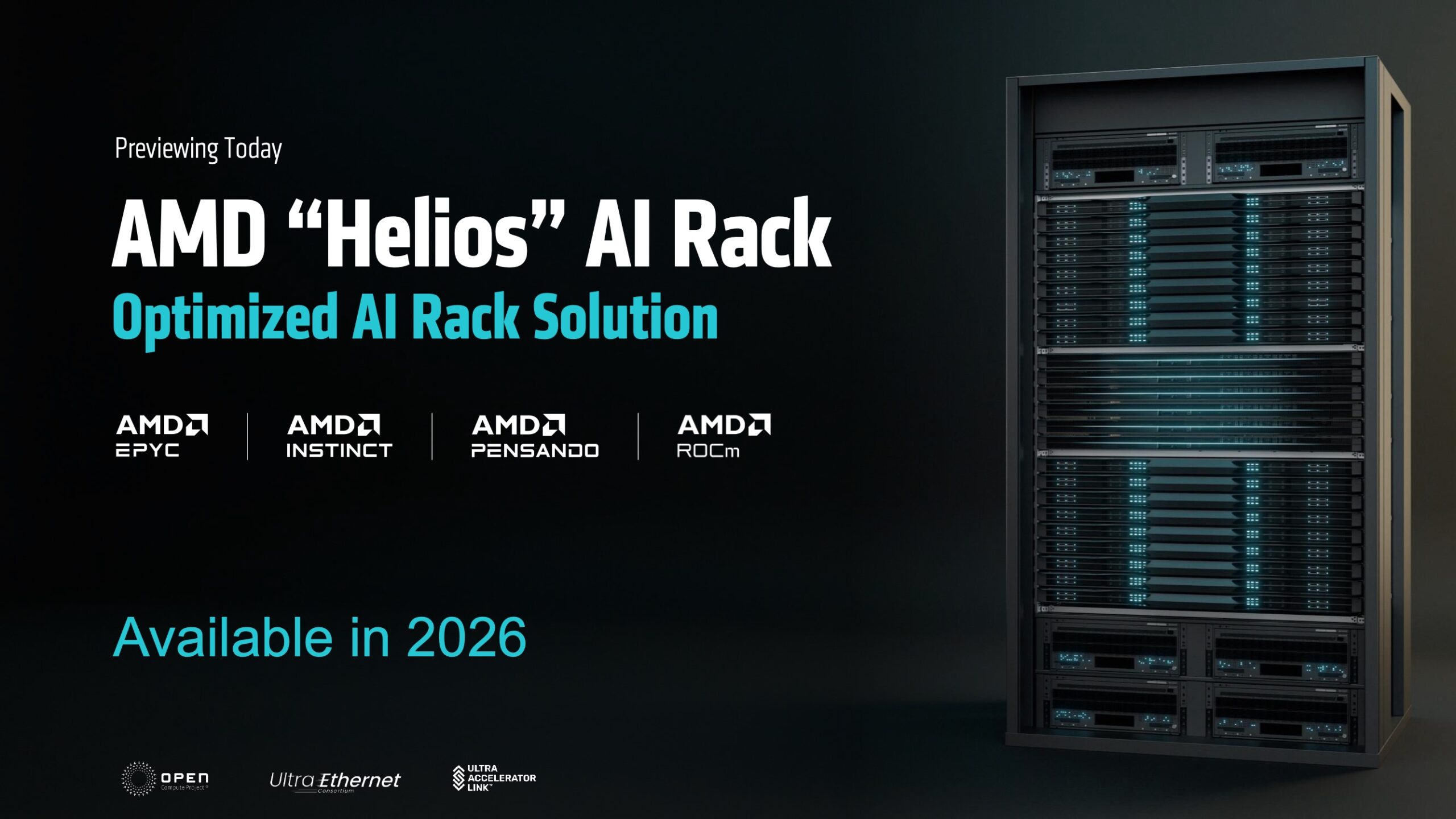
So, NVIDIA's Vera Rubin now has a serious competitor, which will likely come at an equal performance parity, but this isn't the only trick AMD has up its sleeve. The company has revealed that they'll specifically focus on rack-scale AI solutions, part of which was announcing the new "Helio" AI server rack, which will be built on the Instinct MI400 AI accelerators, and EPYC 'Venice" CPUs, offering performance similar to the Rubin NVL144 AI racks. With AMD expanding its rack-scale offers, the company has certainly positioned its AI arsenal to be a direct and capable alternative to NVIDIA's.


AMD has approached the AI market pretty aggressively with this year's Advancing AI event, and the company's extensive product roadmap shows that Team Red is ready to break the long-standing monopoly by NVIDIA. The only thing that would bother AMD is that it is currently on an annual product cadence, while its competitor is around a six-to-eight-month one, putting AMD in the backseat. However, the yearly cadence ensures that all of AMD's AI solutions are ready to be deployed into the markets without issues that occur in unrefined architectures.

About the author: Muhammad Zuhair is a hardware and technology reporter for Wccftech, specializing in the semiconductor industry and the complex interplay between technology, manufacturing, and geopolitics. His coverage focuses on the corporate strategies and technological roadmaps of industry giants like TSMC, NVIDIA, Samsung, and Intel. Zuhair's expertise lies in deconstructing complex topics such as fabrication nodes (e.g., 2nm process), the economic impact of policies like the CHIPS Act, and the strategic development of AI infrastructure from NVIDIA, AMD and Intel.
Follow Wccftech on Google to get more of our news coverage in your feeds.


