


Undervolting the AMD Radeon RX 9070 doesn't downgrade its potential as you would expect. Instead, it increases the performance per watt, making it ideal against its competitors.
AMD Radeon RX 9070 Undervolted by 100mV Delivers Just 4 FPS Fewer Than Default Settings, While Power Consumption Stays at -30%
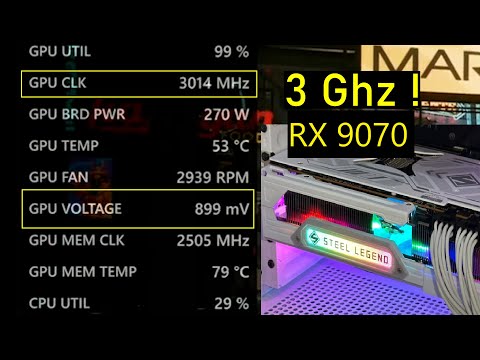
Not just the Radeon RX 9070 XT, but the RX 9070 non-XT is as good as the former when it comes to performance retention at lower voltage. After Der8auer, renowned overclocker, Alva Jonathan from Indonesia, undervolted his ASRock Radeon RX 9070 Steel Legend graphics card, only to find competitive performance while the power consumption drops noticeably.
With default settings, the RX 9070 delivers 54 FPS in the Cyberpunk 2077 benchmark. After a few tweaks to the AMD Adrenalin software, the user reduced the power by -30%. With that, the GPU voltage drops to roughly around 770-780mV from 850-900mV while the GPU clocks drop significantly to less than 2.2 GHz.

By reducing the voltage by -50mV, the GPU clock increases by around 100 MHz while the GPU voltage remains at around 740-750mV. That said, with another -50mV, the GPU clock reaches over 2.4 GHz quickly. This is exactly how Der8auer's RX 9070 XT responded when undervolted. In this case, however, the user says 50-100mV undervolting is stable, but anything above that may result in crashes.

After Benchmarking the GPU again in the game, it was found that the GPU delivers 50 FPS, which is roughly 10% lower than the results at stock power and voltage. This comes out to be 30% better in terms of FPS per Watt compared to the stock settings and still easily defeats the RTX 4070 Ti Super, which only delivered 46 FPS.
The RX 9070 series is really impressive even at lower power consumption and, at just 170W, the RX 9070 showed not much difference compared to the default power consumption of 200-220W. One more thing to notice in the experiment is how the GPU increases easily to over 2.7 GHz with just a 10% additional power increase and goes even beyond 2.8 GHz when undervolted by 50mV, which is impressive.

After reducing the voltage by another -50mV, the clocks reach 2.95 GHz, which is already 250+ MHz over the advertised boost clock of the GPU and helps the card deliver up to 60 FPS, which is a solid 11% uplift over the default settings. There is a lot of potential in both RX 9070 XT and RX 9070 cards because achieving 10%+ performance can be a dealbreaker.


About the author: Sarfraz Khan is a hardware reporter with a focus on PC components and the builder community. With years of experience writing about PC hardware and laptops, his work has been featured on several reputable technology publications. Sarfraz's hands-on experience is demonstrated through his first-person accounts of using and comparing different hardware configurations, providing practical and relatable insights for everyday users. His technical analysis is respected by peers in the enthusiast community and has been cited by specialized hardware sites such as Germany's Igor's Lab.
Follow Wccftech on Google to get more of our news coverage in your feeds.


