


Nintendo has two sides -- there's the company that makes broadly appealing, polished entertainment like Mario and Zelda, and then there's that weird side that makes stuff like Tomodachi Life. While the last Tomodachi Life was a surprising success, moving nearly 7 million units on the 3DS, not many expected a follow-up to the Mii-focused life sim, as it kind of felt like the series’ time had come and gone. There's no keeping the weird side of Nintendo tamped down, though, and so, Tomodachi Life: Living the Dream, a game in development in one form or another for nine years, drops this week.
Is Tomodachi Life: Living the Dream another successful dose of inspired silliness? Or has the gag worn thin? Scroll on for the serious answer.

While they haven't been doing all that much recently, Tomodachi Life: Living the Dream once again puts the spotlight on those bobbleheaded avatars, the Miis. The game specifically encourages you to draw on pre-existing personalities, whether they be your friends and family, celebrities, or even fictional characters, as having a Mii of Tom Cruise fall in love with your Great Aunt Gladys is kind of the series's whole gag.

The Mii editor remains one of the most surprisingly versatile character creators out there, allowing you to spin up nearly anyone with a decent level of accuracy. And if the premade parts aren’t quite meeting your needs, you can now "paint" on characters’ faces, allowing you to draw whatever specific features you want. Gender and dating options have also been expanded, with Miis potentially being male, female, or nonbinary and romantically interested in any combination of male, female, or nonbinary fellow Miis (or simply nobody at all). Perhaps the most interesting part of the whole Mii creation process comes at the end, when you determine how your creation will behave via a small selection of sliders: are they polite or direct? Serious or relaxed? These determine a personality profile, which can be surprisingly accurate.

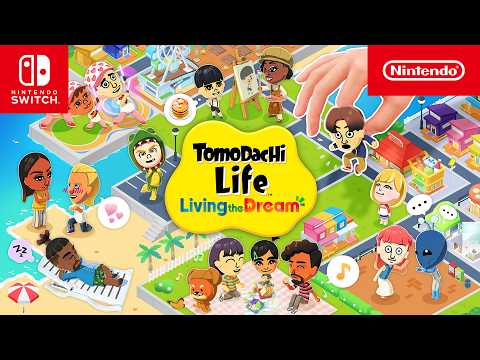
Once you've created a Mii, you drop them into your island community, where they're provided with a basic house and are free to get down to the business of just hanging out. You don't directly control any of the Miis, but instead act as the literal hand of God (you're represented by a large pair of photorealistic hands that you use to directly pluck up and otherwise manipulate your hapless followers). Miis have a lot of requests; they're hungry, they want new clothes, a better-decorated house, etc., and it's up to you to satisfy these needs. Miis also develop relationships with each other, even falling in love sometimes, and you're expected to grease the wheels there, too.
Doing things for your Miis earns a player both money and a type of experience called “warm fuzzies,” with both individual Miis and the island itself leveling up. Leveling up Miis allows you to customize their behavior further, assigning them favorite items to use, various personality quirks, and catch phrases (with the latter potentially going “viral” on the island and popping up in conversations you don’t expect).

Upgrading the island also gradually increases your Godly pool of resources, adding various useful buildings and other features. These include stuff you'd expect if you played the previous Tomodachi Life, including a place to buy food, clothes, and furnishings, a news station that provides a steady stream of wacky updates on your Miis' lives, and various attractions like a restaurant and Ferris wheel that might play host to some unique scenes.
Perhaps the most unique addition to Living the Dream’s lineup of buildings is the Palette House, which allows you to craft your own clothes, food, items, pets, and more, which, in classic quirky Tomodachi fashion, are often represented as basic 2D sprites out in the world. Palette House can be a lot of silly fun, although it is one of the few places you really notice this is a Switch 1 game with no official Switch 2 Edition as of yet (mouse controls would be a nice addition for creative stuff). Thankfully, aside from some control limitations, Living the Dream looks fairly sharp, if simple, running on the Switch 2.

At this point in the review, it may sound like Tomodachi Life: Living the Dream isn't adding much to the original concept, that it's just an HD update of what came before on the 3DS, but that's not really true. On the 3DS, your island was little more than a touchscreen menu and interplay with your Miis was largely passive and limited to vignettes and short snippets of interactivity. The result was a game that felt like an often-amusing gag without a solid core to hold it together. Living the Dream changes this up by having your island be an actual living space, which you can customize to your heart's content, ala Animal Crossing.
Your Miis wander around this customizable island in real-time, dynamically getting into situations with their fellow island residents. Occasionally, a Mii will call out to you, giving you the option to click on them to trigger a cutscene or play a minigame. As mentioned, you also now have the ability to directly interfere with your Miis' relationships, as plucking one up and dropping it next to another Mii will trigger some sort of social interaction.

These Sim-like additions transform Tomodachi Life: Living the Dream into a far more absorbing experience. A fully-realized game, rather than a tossed-off gag. That said, this is a game that still expects you to make your own fun to a large degree. While Living the Dream delivers a steady stream of new stuff to tinker with early on, eventually things start rolling out at a slower pace, and the game doesn't really provide you with any goals or a clear explanation of how things are unlocked. Also, while the game’s tutorials claim Miis will form relationships on their own, things progress very slowly if you remain hands-off. If you want juicy stuff like romance and marriages to happen, you gotta keep bumping your Miis together until they get the picture.

If you stay proactive and keep steadily building, creating new Miis (you can add up to 70 to your island) and actively overseeing their social lives, things will continue to happen, but if you don't, life on the island can start to feel a bit stagnant. Frankly, Living the Dream could also use a bit more variety in its conversations and scenarios. Certain common occurrences, like Miis making friends for the first time, only play out in a few different ways, and I started to get tired of seeing the same back-and-forths. And really, how many times can you still be bothered to feed a Mii a donut or buy them a new hat?
Make no mistake, though, there's something oddly compelling about Tomodachi Life: Living the Dream. Even after having the game for a while, I still regularly find myself losing 3 or 4 hours to it at a time. Putting off other things I have to do because I have just one more little thing I want to accomplish. Also, while Nintendo has unfortunately limited some ability to share your creations online, being on a console rather than a dedicated handheld like the 3DS is a great boon to Living the Dream, as it's a great living room shared experience. As much as I wish there were a few more amenities, this is a hard island to escape.
This review was based on a copy of Tomodachi Life: Living the Dream provided by publisher Nintendo.


About the author: Professional writer of trivial things. Nathan has been covering games, entertainment, and online culture for over a decade with bylines at IGN, GameSpy, Cracked, Uproxx, ComicBook, and more. Joined Wccftech gaming team in 2017, and has written hundreds of game reviews and thousands of news stories since.
Follow Wccftech on Google to get more of our news coverage in your feeds.


