


Ask JRPG veterans to name the top ten titles in the genre and you'll routinely hear one title being namedropped near the top of that list: Dragon Quest VII. It was an experimental and moody title, focused around an opening act that sets the tone for the adventure with three young children learning about the sole island left in the world and why the world has been trapped away for hours before hearing that iconic battle theme. Now the second time that this adventure has been remade, is Dragon Quest VII Reimagined more of the same with a brand new look, or has Square-Enix set off to redefine what the standards of being a Japanese Role-Playing Game should be?
In both the original PSX version and 3DS remake of Dragon Quest VII, it was (in)famous for having one of the longest introduction sequences before players even set foot in their first battle, often taking players nearly three hours before they bump into their first Slime. In Dragon Quest VII Reimagined, that prologue has been massively streamlined, getting players acclimated to the single island, picking up a few map shards here and there, and making their first trip through the Shrine of Mysteries to the world of the past, in less than half that. It was a properly bold move in the original game to spend so much time on just building up the worlds and setting up the vibes for the adventure that it would be impossible to replicate in this day and age of players wanting instant gratification. Because of this, the sense of being the lone island left in the world loses some of its impact and instead feels like the intro has been rushed to keep the focus of ADHD-raddled gamers.

The core loop for much of Dragon Quest VII Reimagined remains the same from the original game: acquire enough map shards to unlock a portal to the past, solve whatever great calamity struck that island before it was locked away, venture forth to the same island in the present and see the impact of your actions, and pick up enough shards to unlock the next island map. Rinse and repeat, with novel deviations here and there along your journey to slay Orgodemir. This formula takes a huge turn during the game’s third and final act, resulting in a stark change in setting and ability to freely explore the world, which stands out as one of Dragon Quest’s best chapters in the entire series. While the adventure is massively funneled down from feeling like an open-world adventure to one where players are once again on rails for much of the journey, it’s still an enjoyable ride to the finish line, even if much of the challenge has been tapered off along the way.
No surprises to anyone who’s played the series before: combat is your standard Dragon Quest turn-based affair here. Your party of four heroes ventures onto the battlefield in a row, and players pick their actions individually while rounds play out with player and enemy alternating attacks based on the speediest of the bunch. Every individual attack and spell is animated uniquely, giving each battle a visual flourish that is sometimes lost in JRPGs. While there are options to speed up battle, there isn’t an option to skip these animations, so you’ll be hearing a lot of that iconic spell jingle each time Maribel’s turn comes up. The occasional guest character will venture alongside the party of four, giving players some much-needed support or an extra attack from time to time.

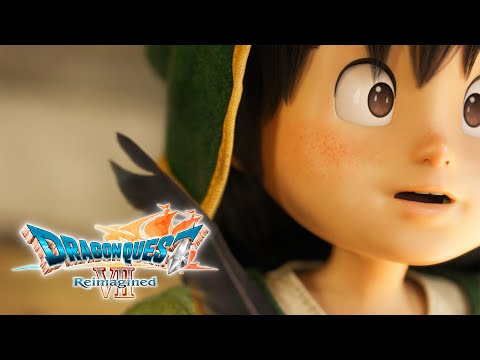
Dragon Quest VII Reimagined is the best-looking entry in the long-running JRPG series, and it’s no wonder why. Every room that the party ventures into looks like a miniature diorama, taking inspiration from Mistwalker’s Fantasian, with the added benefit of being able to rotate the view rather than being limited to a fixed camera angle. It’s the little attention to detail that makes Eden feel properly lived in: uneven stacks of wooden bowls in a restaurant sink, footprints left behind in the sand when running through the corridors of a village in the middle of a desert. There’s such a rustic charm to the world that makes Dragon Quest VII Reimagined feel like a world that’s been lived in for hundreds of years.
On the character front, the same attention to detail is twofold. While your standard NPCs all suffer from the signature blank stare that Akira Toriyama’s background characters were known for, characters more integral to the story are given much more interesting presentation; think Yakuza’s cadre of copy-and-pasted denizens, but on a far more intimate scale. Compare that to the focus given to the half-dozen party members that the Hero brings along for an adventure to save the world. Each of these heroes looks like a toy brought to life with some of the finest character modeling this side of a Kojima Productions game. I wouldn’t be surprised to see Square-Enix license out the heck of this game with collectible figurines of Ruff and his mother wolf looking identical to his in-game counterpart. While you lose some of that next-gen definition, like hair physics, the realistic cloth modeling gives each hero's attire that stands out against the weathered environments.

On the topic of attire, that’s one of Dragon Quest VII Reimagined’s biggest drawbacks. In the original releases, each vocation bestowed upon the hero a unique costume that completely changed their appearance based on their current job. While I get that modeling twenty-two different costumes for each hero would be quite the undertaking, leaving the only amount of character customization to the weapons they bring into battle is quite the choice. Playing the Dragon Quest VII Reimagined demo and loading a save into the full game rewards Maribel with the Day Off Dress, a marigold-hued nightgown, which remains the only actual ensemble that players can unlock during regular play, at least without the cost of real money. Square-Enix has offered a few different bundles for the digital edition of Dragon Quest VII Reimagined that give the band of heroes costumes based on the roster of Dragon Quest XI: Echoes of an Elusive Age (with Maribel once again getting an additional costume above everyone else).
Even worse than losing vocation liveries is the removal of any real difficulty from Dragon Quest VII Reimagined. What remains one of the longest entries in the series has also been neutered down into one of its simplest and easiest to complete. Any friction and challenge have been sanded down and trimmed away to streamline this entry and make it more accessible to a new generation of JRPG fans. In the original, it was often a puzzle to figure out which age and location might hold enough map shards needed to create a portal to another island; here, handholding and constant reminders from the caretaker of the Shrine of Mysteries clue the player in on where to go next to uncover a critical key item. Party Chat, by way of the Circle Button, offers up a brief quip from a party member clueing the player in on where to head off to next.

Players can customize their challenge through a variety of sliders, ranging from the amount of experience earned to both the damage dealt to and received from enemies, and even being able to restore the party’s HP after every encounter. All in all, these are just numerical tweaks and don’t give enemies new attacks or tactics to contend with, and players can always use the Auto Battle feature to breeze through repeated encounters and grind with ease. Symbol encounters on the overworld let players see enemies rather than random encounters, and swinging your sword at them will either result in taking the initiative in combat or, if the Hero’s party outlevels that of the enemy forces, will kill them outright, netting the player a fraction of the experience and gold they’d otherwise entail. For grinding out the last few levels of every vocation, I’m guilty of taking full advantage of that and mercilessly slaying slimes for a few vocation proficiency points at a time.
The Vocation system in Dragon Quest VII Reimagined has always been intended to allow players to build the party of their dreams, eschewing archetypes for a given character and instead letting them become any class they choose. Want your primary Hero to be the party’s healer while Maribel plays the role of Pirate? That’s only a quick call away to your career coach at Alltrades Abbey through a key item that lets you freely change up your given job whenever you like (no more having to wait until you unlock Sage to get that feature). Towards the back half of your adventure, players will also unlock the ability to Moonlight as a second class, gaining both the statistical increases and skills of that second class. While on paper this lends itself to being more flexible and having unique party setups for every player, in practice, this results in every character maining the Hero vocation and then Moonlighting as either a Champion or Druid, depending on whether you prefer to have a physical attacker or magical supporter. Gone are the Monster vocations (Monster Hearts are instead equippable accessories rather than brand new classes) and the ability to carry over any skill/spell from the Intermediate and Advanced vocations if you aren’t currently adventuring as that given class.


What was once an 80-100 hours long adventure on the conservative side can now be finished in roughly half that, coming in at around 50-60 hours for your average playthrough, depending on your appetite for grinding out vocation levels or mini medal hunting. Padding that time are the necessary trophies to collect every mini medal, and as a result, every item in the compendium. Many of the rarest items in Dragon Quest VII Reimagined are found in Lucky Panel, the sole minigame of Pilgrim’s Rest, which once hosted a bevvy of other casino games in the original game. Your Match Two skills will be put to the test for hours on end as you try to match enough panels to unlock rare gear, which, if you wait until the postgame to unlock the remainder of these items, will easily be outclassed by the other weapons and gear players might pick up by way of the Coliseum or other challenging side quests. I may be bitter about the time I had to waste to unlock every single item, but my actual playtime was ballooned up to almost 90 hours because of the sheer amount of Lucky Panel I had to play through just to acquire less than ten unique items from that particular minigame.
If nothing else, Dragon Quest VII Reimagined is simply the best-looking entry in the three-decade-old role-playing series by a long shot. While any amount of friction and challenge (the little that is left easily overcome with the help of the guides in our Dragon Quest VII Reimagined Walkthrough and Guides Hub) has been smoothed out to barely more than a splinter’s prick, this time-traveling adventure is perfect for players who want to dip their toes into the JRPG series without having to worry about superfluous calendar deadlines in the Persona series or reaction-based gimmicks in Clair Obscur: Expedition 33. My final score reflects how the title respected my time and offered next to no challenge during normal gameplay, and it goes without saying that the amount of care and detail put into the presentation far exceeds the listed score.
[Editor's Note: Dragon Quest VII Reimagined was reviewed on the PlayStation 5 Pro. Review code was provided by the publisher.]


About the author: Kai joined the gaming team of Wccftech in 2016 and has since penned over a hundred reviews and interview pieces, covering a bit of everything from one-man indie gems to AAA masterpieces and whatever lies in between. Over the recent months, Kai has expanded into preview and interview coverage of not only the gaming side of the industry but also tech and consumer electronics.
Follow Wccftech on Google to get more of our news coverage in your feeds.


