


New GPUs are optimized substantially for AI workloads, but what if old GPUs like the 8-year-old NVIDIA V100, costing around $100, start to outperform recent offerings in LLMs?
NVIDIA V100, an 8-Year-Old GPU, Dusted The 5-Year Old RTX 3060 & 3-Year Old RX 7800 XT With Better Performance & Efficienct In AL LLMs
The NVIDIA Volta generation was the first purely dedicated data center series that wasn't available in the standard consumer gaming segment. Volta was the first family to feature the Tensor Core architecture, which has since become the staple for its AI advancements. The tensor core architecture was designed to handle AI tasks and has evolved massively since the Volta family, but Hardware Haven decided to test an 8-year-old V100 GPU to see how it holds up in modern-day AI LLMs.
But first, let's recap the specifications of the NVIDIA Tesla V100 GPU. The Tesla V100 was available in two distinct form factors, an SXM board and a PCIe variant. The SXM models were housed primarily in data centers using a mezzanine connector, which allowed direct power and NVLink routing.

The V100 tested is an SXM2 model, which features 5120 cores, 320 TMUs, 128 ROPs, and 640 Tensor Cores. It packed 6 MB of L2 cache, a clock speed of up to 1530 MHz, and either 16 or 32 GB of HBM2 memory across a 4096-bit wide bus interface, resulting in 898 GB/s bandwidth. The GPU had a 250W TDP, which feels minuscule vs the current 1KW+ Blackwell models.
Back then, the NVIDIA Tesla V100 was priced at over $10,000 US, but today, it can be bought off eBay for just $100 US for the 16 GB variant.

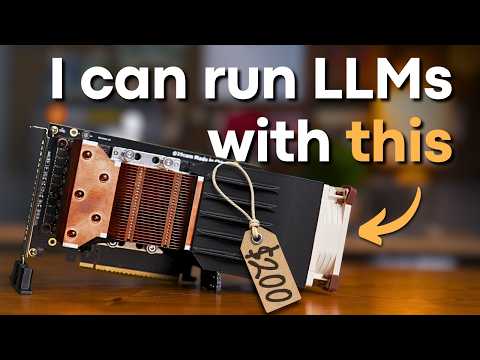
But the main problem isn't the price of the GPU, it's compatibility with a standard PC. No PC supports SXM2 standards. This required an SXM to PCIe adapter, which comes with its own dedicated 2x8-pin connector configuration and three 4-pin fan headers.

The other hurdle was the cooling solution. The NVIDIA Tesla series is designed for large-scale data centers and runs passively with a large heatsink. The heatsink and backplate on the GPU are high-end, but not able to sustain a 24/7 operation inside standard PCs. This required the techtuber to come up with his own cooler duct, which was 3D printed, and a single Noctua fan that offered direct airflow to the heatsink.

The total cost of the GPU and the add-ons ended up slightly over $200 US, which is still lower than the models used for comparison, such as the RTX 3060 12 GB and the RX 7800 XT 16 GB.

The first AI LLM used for testing was GPT-oss with 20b parameters. Here, the NVIDIA V100 system was able to produce around 130 Tokens/s versus the RX 7800 XT, which only managed around 90 Tokens/s.


Compared to the NVIDIA GeForce RTX 3060 12 GB, which is roughly 5-years old, the NVIDIA V100 was 42% faster in Gemma4:e4b (ollama+openwebui) in token generation speed. What's more impressive is the power efficiency of the 8-year-old GPU, which, although it had a higher power draw, was 12% ahead of the newer Ampere-based GPU.
The GPU was also tested with a 100W power limit, where it once again outperformed the RTX 3060 with a 41% lead in power efficiency in token/sec/watt tests.


While this proves that older GPUs are still viable for AI LLMs, offering great value and efficiency, they do require extra modding, which isn't up to everyone to perform. The 32 GB model does cost around $400 - $500 US, but the extra memory capacity can further help in bigger AI LLMs. With that said, the tech outlet aims to do additional testing in the future, so be sure to check out their channel and the complete video below:


About the author: A Software Engineer by training and a PC enthusiast by passion, Hassan Mujtaba serves as Wccftech's Senior Editor for hardware section. With years of experience in the industry, he specializes in deep-dive technical analysis of next-generation CPU and GPU architectures, motherboards, and cooling solutions. His work involves not only breaking news on upcoming technologies but also extensive hands-on reviews and benchmarking.
Follow Wccftech on Google to get more of our news coverage in your feeds.


