


With the launch of FSR 4 last year, AMD finally matched Nvidia's DLSS upscaling technology after nearly 6 years of not having a comparable solution. FSR 4 was widely praised by third-party reviewers, with the general consensus being that it was somewhere between DLSS 3 "CNN" and DLSS 4 "Transformer" in terms of image quality, with slightly worse performance than DLSS 4. However, with the release of DLSS 4.5 at CES 2026, it appears that Nvidia is once again poised to open up a lead in upscaled image quality.
DLSS 4.5 - Second Generation Transformer Explained
DLSS 4.5 achieves a quality improvement over DLSS 4 by numerous changes. Most notable are the following:
- 2nd generation Transformer model
- Significantly larger, higher fidelity training set
- Increased compute cost (5X higher than DLSS 4)
- FP8 on RTX 4000, 5000 (offsetting performance penalty)
You can use DLSS 4.5 on a per-game basis by going to the Nvidia App, selecting your desired game, scrolling down to the Driver settings, and changing DLSS Override - Model Presets to Preset M (Performance) or Preset L (Ultra Performance mode). Today, we'll just be taking a look at Preset M.

Test Setup
In order to compare the current state of Nvidia and AMD's premier upscaling technologies, I'm going to be using the RX 9060XT 8GB (for FSR4) and the RTX 5060 Ti 16GB (for DLSS 4.5). Both of these will be plugged into my testing rig, which has the following specs:
- i7 13700k (on MSI Performance Settings)
- MSI Z790MPower motherboard
- 2x16GB DDR5 7200 RAM
- Seasonic Focus V3-GX 1000W PSU
- Arctic Liquid Freezer II 420MM AIO
- 2x SN850X 1TB SSDs
- Windows 11 24H2
- AMD Radeon Adrenaline Driver 25.12.1
- NVIDIA GeForce Game Ready Driver 591.74
Most of the games I've tested had native FSR 4 implementations (either via the in-game menu, as in Cyberpunk 2077, or an in-driver upgrade like offered for Clair Obscur: Expedition 33). However, I also tested Forza Motorsport with FSR 4 enabled via Optiscaler using DLSS inputs, just as an experiment.
Note that Black Ops 7 does not expose the Driver Settings options on the Nvidia App when owned through Game Pass. Therefore, to enable the M preset for this title, I used DLSS Swapper. However, this is not recommended as an actual solution to use DLSS 4.5 for multiplayer titles.
Capture footage was recorded using each video card's respective hardware encoder, as I don't currently have a dedicated capture card setup. Therefore, please note that the footage recorded for the 5060 Ti may appear sharper in certain scenes due to the superior encoder available on that card. Games were tested at 1440P with performance mode upscaling enabled, which equates to 720P internal resolution.
A Quick Note On Performance
Preset M can be demanding on pre-Lovelace hardware, as it is a native FP8 model and therefore requires translation to a different precision format for inference on older cards. On the 5060 Ti, it has roughly the same cost as regular Transformer presets. FSR 4 is also in the same ballpark of performance. Since our 9060XT and 5060 Ti have roughly the same raw rasterization performance, this means that neither is afforded an undue advantage by means of higher FPS, which gives the upscaling model more motion data to work with.
Cyberpunk: 2077
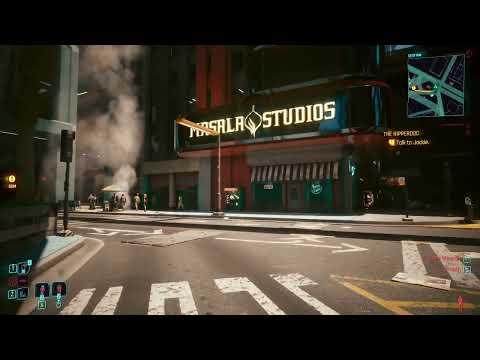
Starting with Cyberpunk 2077, I had similar impressions for both solutions in terms of overall image quality. Obviously, performance mode upscaling at 1440P is a good deal less sharp than 1440P Quality, but overall, both FSR and DLSS rendered a totally usable image, if not without their respective artifacts.

Certain elements, like neon lights and textured walls, both exhibited intense, distracting shimmering, while edge aliasing was overall kept in check. One area where DLSS outperformed FSR was in disocclusion artifacts, especially around foliage. With DLSS 4.5, such artifacts are noticeable, but only if you're looking for them, whereas with FSR 4, they're noticeable even in quick motion. Overall, I'd call it a tie in this game.
Hogwarts Legacy
Moving on to Hogwarts Legacy, DLSS takes a clear lead here. Overall clarity is better, thanks to the more aggressive sharpening of the M preset. Ghosting is well controlled with both upscalers, but FSR does bungle the foliage somewhat: as you can see clearly in the footage, panning the camera (even slightly) adds a lot of "background noise" to the foliage, which takes a second or two of stillness to resolve.

This has been an issue in certain games for FSR 4 since day one, which goes to show how unchanged the upscaler has remained. DLSS does struggle a bit with noisy foliage in motion, but it's not nearly as pronounced as FSR, and overall, I'd have to hand DLSS 4.5 the win here.

Clair Obscur: Expedition 33
Next up, we've got Clair Obscur: Expedition 33. This game has always had a poor native representation, owing to heavy processing effects that blur the image, and as such, upscaler quality is crucial to the experience in this game.

FSR4 tends towards a slightly softer image, as Preset M adds a heavy dose of over-sharpening. Both provide a near native experience (native being a pretty poor showing in this game anyways) with no real additional ghosting, nor any real shimmering or jaggies (apart from noisy reflections, due to Lumen).

Both upscalers suffer from the same image quality issues plaguing the native presentation of the game: boiling, noisy reflections (caused by low resolution Lumen), gross amounts of disocclusion artifacts, and shimmering around elements like hair and cloth, and ghosting around small particles like the red leaves omnipresent throughout the game. However, overall, I'd say Preset M's additional sharpening works in its favor for this game, as the base image is unreasonably soft, which nets it a close victory.
Call of Duty: Black Ops 7
Black Ops 7 is a tougher title to test for image quality. The in-built benchmark is designed to be fast-paced with rapid camera panning and intense effects like explosions right in your face. I've gone frame by frame through some of the footage to hopefully discern some differences in motion clarity, but my analysis only revealed what was visible to the naked eye: both of these upscalers are roughly matched for motion clarity - at least to my eyes; maybe FPS pros can see a difference.

As you can see in the footage, both of these upscaling solutions preserve impressive amounts of sharpness and motion clarity despite the low internal resolution of 720P.

Forza Motorsport
Forza Motorsport is a title I tested as an experiment of sorts. Given that it doesn't natively support FSR 4, I had to install Optiscaler, which allows FSR 4 to be used via the game's DLSS inputs. This is actually how I used to play the game back when I had a 9070XT, which worked really well with 1440P FSR 4 Quality.

However, I was surprised to see an unusually drastic reduction in image quality when using 1440P FSR 4 Performance mode. Reconstruction of trees and foliage is not great, which is atypical of FSR 4 Performance at 1440P. I could actually observe some ghosting of the taillights of cars ahead of me, which again is quite rare to see with FSR 4. Overall, the experience lagged far behind DLSS 4.5, which goes to show why it's so important for vendors to emphasize official support for upscaling solutions, as community solutions can often times fall apart in certain scenarios.

Obviously, the results in this title should be taken with a grain of salt, as the FSR 4 implementation isn't by any means official.
Conclusion - DLSS 4.5 delivers quality gains, but doesn't quite leave FSR 4 in the dust
After testing 5 games with 1440P Performance upscaling using both DLSS 4.5 M preset and FSR 4, I would say that DLSS has a slight advantage now. Preset M turns the sharpening up to eleven, which has benefits for games with softer native presentations, giving it an edge for such titles.
However, it isn't a magic bullet, and generally, overall quality is in the same ballpark as FSR 4. The main advantage of DLSS upscaling, in my opinion, continues to be much better game support, and although Optiscaler can be used to inject FSR 4 into games without native support, results can be mixed, as we saw with Forza Motorsport.


About the author: Rayan is an aspiring Computer Engineer, currently pursuing his undergraduate studies. He built his first computer in the pandemic, and has been hooked on the hobby ever since. He brings a unique blend of academic knowledge and technical know-how to his articles, which include everything from detailed instructional guides to performance comparisons in wccftech hardware section. When not stressing out over finals or writing articles, you can find him reading fantasy books or hitting the gym.
Follow Wccftech on Google to get more of our news coverage in your feeds.


