


Intel's Gaudi 3 AI accelerator has officially been adopted by IBM Cloud. This marks the first instance of a CSP adopting Gaudi 3 into its portfolio, an exciting development.
IBM Becomes The First CSP To Offer Intel's Gaudi 3 To Its Customers, Offering a Cost-Effective Alternative To NVIDIA
Team Blue's AI venture hasn't been as bright as its competitors, given that the firm didn't capitalize on the AI hype early on. The company hasn't managed to find a hold over the industry even now, which is why the adoption rates with Intel's Gaudi AI lineup are much lower. However, IBM Cloud has become the first CSP to reveal the availability of Intel's Gaudi 3 AI accelerators, and this is an attempt to deliver cost-effective solutions to clients, according to the CSP.
By bringing Intel Gaudi 3 AI accelerators to IBM Cloud, we’re enabling businesses to help scale generative AI workloads with optimized performance for inferencing and fine-tuning. This collaboration underscores our shared commitment to making AI more accessible and cost-effective for enterprises worldwide.
- Saurabh Kulkarni, VP at Intel
Clients can access the computational capabilities of the Gaudi 3 AI accelerators using IBM's Cloud Virtual Servers, and interestingly, Signal65 has managed to test out the accelerator on the platform and has revealed performance relative to NVIDIA's H100 and H200-based GPUs. This will also mark the first time Intel's Gaudi 3 has been tested apart from internal ones, and the results have shown us that Intel could put a competition in the AI segment if they play their cards out correctly.

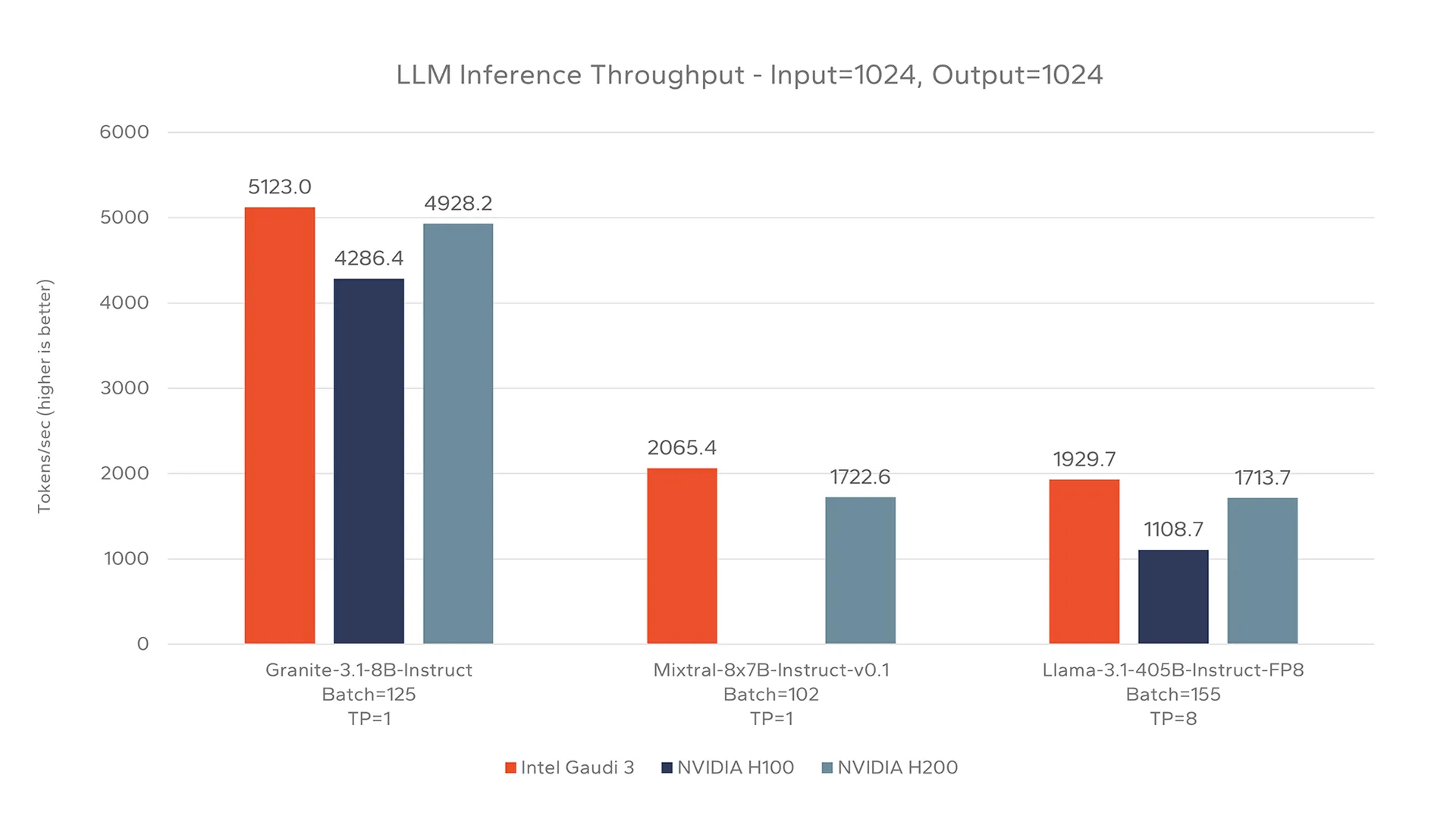
The benchmarks reveal that Intel's latest accelerator outperforms the NVIDIA H100 and H200 AI accelerators on both IBM's Granite (8B) and Meta's Llama-3.1 models. The parameters were specific to each test run, meaning that in real-world usecases, Intel's Gaudi 3 might not reflect the same performance, but these results were interesting. Benchmarks were further done on variable input sizes, and here's what Signal65 concluded:


About the author: Muhammad Zuhair is a hardware and technology reporter for Wccftech, specializing in the semiconductor industry and the complex interplay between technology, manufacturing, and geopolitics. His coverage focuses on the corporate strategies and technological roadmaps of industry giants like TSMC, NVIDIA, Samsung, and Intel. Zuhair's expertise lies in deconstructing complex topics such as fabrication nodes (e.g., 2nm process), the economic impact of policies like the CHIPS Act, and the strategic development of AI infrastructure from NVIDIA, AMD and Intel.
Follow Wccftech on Google to get more of our news coverage in your feeds.


