


It appears that the Chinese firm Moore Threads wants its share of the AI market, as the firm has released a new upgrade to its MUSA SDK, an alternative to NVIDIA's CUDA stack.
Moore Threads MUSA SDK Now Supports Intel & ARM Processors; Also Allows Code Porting From NVIDIA's CUDA Stack
When it comes to software capabilities, NVIDIA has managed to dominate the industry with its CUDA ecosystem, offering not only high-end support but also speedy updates. Team Green ensures that competitors cannot see any breathing space. However, with evolving geopolitical conditions, it has become difficult for Chinese tech giants to rely solely on NVIDIA, and keeping this in mind, the domestic GPU manufacturer Moore Threads has brought in new advancements to its MUSA SDK in an attempt to increase its adoption.
Moore Threads's AI software stack is designed specifically for the company's GPUs. It allows parallel computing and AI workloads across various platforms. It features runtime libraries, drivers, and instruction sets to enable the environment to be used with existing systems. The MUSA SDK is divided into multiple components, ranging from dedicated toolkits to application-specific libraries, which we'll discuss ahead.

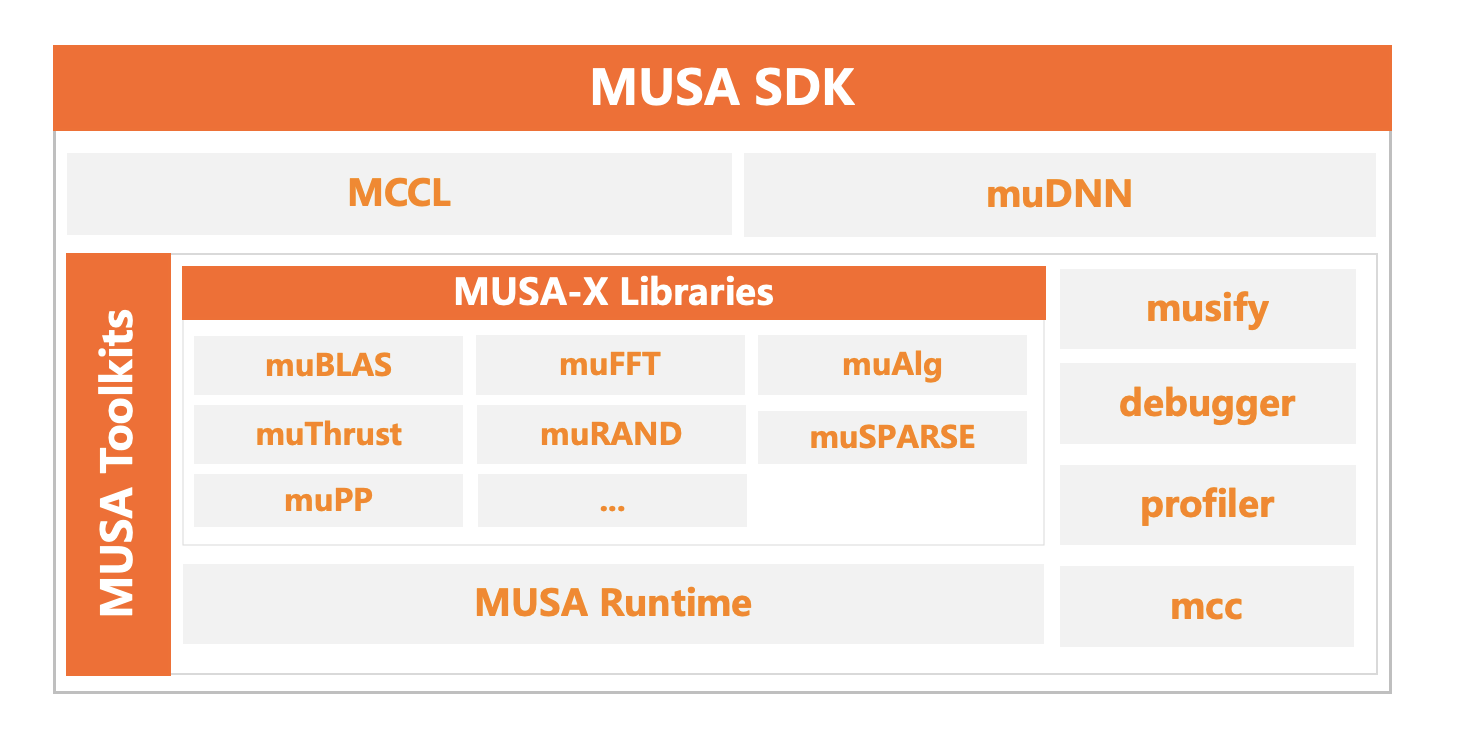
Apart from all the runtime libraries, an interesting fact about MUSA SDK is that it includes a "code-porting" tool called the MUSIFY, which allows developers to port CUDA-based code to MUSA's ecosystem, enabling seamless adoption. Along with this, the MUSA SDK supports libraries lik muBLAS, muFFT, and muThrust, which are intended for specific applications like mathematical operations or accelerated computing.
With MUSA SDK's latest 4.0.1 version, the stack now supports Intel processors, along with the domestic Hygon, Kylin, and Loongson CPUs, which are employed in traditional workloads. While Moore Threads cannot compare with the likes of NVIDIA's CUDA at all, by providing a domestic solution, it allows small-scale developers to access libraries on in-house GPUs without spending too much on NVIDIA alternatives, and of course, there's always an element of patriotism involved, even in tech.


About the author: Muhammad Zuhair is a hardware and technology reporter for Wccftech, specializing in the semiconductor industry and the complex interplay between technology, manufacturing, and geopolitics. His coverage focuses on the corporate strategies and technological roadmaps of industry giants like TSMC, NVIDIA, Samsung, and Intel. Zuhair's expertise lies in deconstructing complex topics such as fabrication nodes (e.g., 2nm process), the economic impact of policies like the CHIPS Act, and the strategic development of AI infrastructure from NVIDIA, AMD and Intel.
Follow Wccftech on Google to get more of our news coverage in your feeds.


